
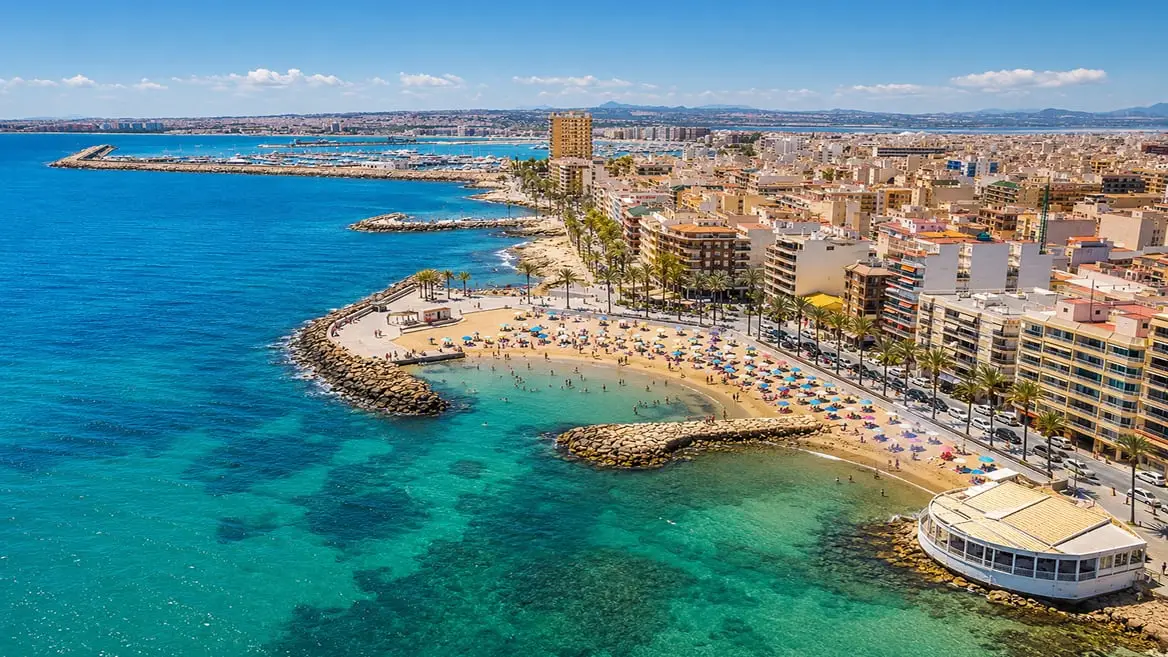
Torrevieja and La Mata are often mentioned together, sometimes as though they are interchangeable. Geographically they belong to the same municipality. In everyday life, however, they can feel like quite different places to call home.
One offers a larger urban centre, a harbour and a broad spread of services. The other is a smaller seaside community whose daily routine is closely connected to its long beach. Neither is automatically the better choice. What matters is the kind of day you want to have once the novelty of moving to the Mediterranean has settled.
First, understand what you are comparing
Torrevieja is a city with distinct neighbourhoods, so “living in Torrevieja” can mean a central apartment close to shops and promenades or a quieter residential setting further from the water. La Mata is one of its coastal areas, with its own village centre, beachfront and surrounding residential streets.
This is not a comparison between a large city and an isolated village. Both are part of an established coastal municipality, and both are influenced by tourism. The distinction is one of scale, layout and the everyday places within easy reach of a particular address.
Choose by the errands you make every week
Start with a question that sounds unromantic: where will you buy groceries, visit a pharmacy, collect a parcel or catch a bus? A home can have a wonderful terrace and still be inconvenient when you need something on an ordinary Tuesday.
In central Torrevieja, many addresses give residents a choice of shops and services within walking distance. Depending on exactly where you live, there may also be more opportunities to walk to appointments, cafés and different parts of the waterfront. The trade-off can be traffic, summer activity, parking pressure and noise on certain streets.
In La Mata, the village area has everyday amenities and a Wednesday street market on Avenida de Francia; living near the centre can feel pleasantly manageable on foot. Yet not every address marketed as “La Mata” is equally close to the village. Some residential streets lie up hills or farther from regular services than a listing photograph suggests. Check the real walking route, not just the distance measured in a straight line.
How important is the beach?
La Mata has a clear advantage for people who love a long sandy shoreline. The beach extends for more than two kilometres, making it particularly appealing for walks at different times of the year. Sections beside the protected dunes add a sense of open space, although they must be enjoyed from permitted paths.
Central Torrevieja offers a different coastal experience: urban beaches, bathing areas, promenades and the harbour atmosphere. Playa del Cura and Los Locos have their own character, and a seafront walk can take you through busier parts of the city.
Neither coastline is uniformly quiet or uniformly crowded. A visit on a Sunday in August will tell you something useful, but so will a weekday in February. If you hope to live here all year, make time for both.
The seasonal rhythm matters
Both locations change with the seasons. The difference is not as simple as saying that Torrevieja is busy and La Mata is calm. It depends on the neighbourhood and the building. Some streets remain active throughout the year; others have a much stronger holiday-home rhythm.
When viewing a home, notice whether the nearby businesses are genuinely year-round, whether you can walk comfortably in the evening and what the street might sound like when surrounding holiday apartments are occupied. A quiet visit outside peak season can hide a lively summer; a busy summer viewing can conceal a more peaceful autumn.
Ask about the building too. Permanent residents, seasonal owners and short-term accommodation can create different patterns of use. None of these is inherently a problem, but knowing what to expect makes the decision more informed.
Transport, parking and independence
Torrevieja has local bus services, taxis and connections beyond the city, including airport and regional routes described by the municipal tourism department. That does not mean every residential street has a convenient service at the time you need it.
If you do not plan to drive, check the current public-transport route from the actual property to the places you will use. Walk the nearest stops, examine service frequency and consider how the journey feels in hot weather or with shopping bags. If you drive, ask where residents park during the summer and whether a private parking space is included.
La Mata can work beautifully for someone who wants most days to revolve around local errands and the beach. But if your routine involves frequent trips to medical appointments, other towns or inland services, convenience deserves as much attention as the view.
What about families, remote work and retirement?
Different households will weigh the same details differently. For parents, the practical questions concern schools, childcare, after-school activities and the daily journey. For remote workers, reliable internet, a genuinely quiet workspace and summer noise may be more important than proximity to a beach bar.
For people planning retirement, the ability to walk safely to routine services and reach healthcare matters over the longer term. Accessibility should be judged at building level: lifts, entrance steps, slopes, pavement condition and how usable the home is during an illness or injury.
There is no reason to assume all newcomers want the same lifestyle. Some thrive with activity on their doorstep; others prefer a modest routine and plenty of space to walk.
A sensible checklist before choosing
- Walk your real routes: from the front door to groceries, transport and the beach, ideally at the times you would normally go.
- Visit twice: one peak-season day and one ordinary day outside summer reveal different things.
- Check the home itself: insulation, ventilation, sun exposure, damp, lifts and community costs affect comfort as much as the location.
- Test transport: verify up-to-date timetables rather than relying on a bus-stop symbol on a map.
- Listen to the surroundings: street noise, construction activity and neighbouring uses can matter every day.
- Ask independent professionals: legal, technical and tax questions should be checked before committing to a purchase.
So, Torrevieja or La Mata?
Choose central Torrevieja if a broader urban setting and a choice of everyday services fit the way you live. Give La Mata serious attention if the long beach, smaller centre and relaxed coastal routine are what bring you to Spain. But do not make the decision from a regional comparison alone: the street and the building can matter more than the name of the area.
A useful exercise is to spend a full ordinary day in each place, not just a few hours on a viewing tour. Buy groceries, take the bus, sit in a café and walk home. You may find that the right answer feels obvious once you stop imagining a holiday and start imagining a Tuesday.
For a closer look at the setting, read our La Mata village and beach guide and our broader article on choosing a year-round coastal town.